
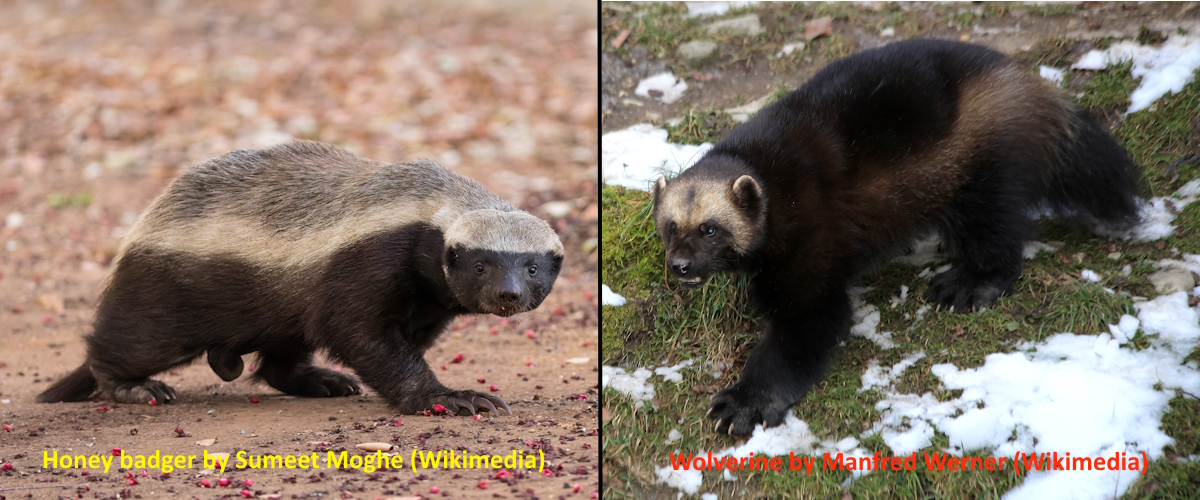
Honey badgers and wolverines are two of the world’s most charismatic animals. The YouTube video that made the phrase “Honey Badger Don’t Care” famous has been seen tens of millions of times. And wolverines have gained a reputation as one of the most fierce animals on earth. To further support the wildlife charisma of honey badgers and wolverines, the last two videos (to the right or below on phones) show that both species can also be playful and adorable when bonded with people.
Given their popularity, it’s not surprising that discussions about honey badgers (Mellivora capensis) and wolverines (Gulo gulo) pop up online, and in one discussion that I saw recently, a commenter stated that honey badgers and wolverines are closely related.
And yes, they are … sort of.
The issue of close-relatedness got me thinking about what we mean when we say animals “are related to” each other. As far as we know, every living organism is descended from LUCA, the Last Universal Common Ancestor, a presumed single-celled organism that first began multiplying at least 3.5 billion years ago. In that sense, I’m “related to” a bacterium, a fungus, a squid, and a chimpanzee. We’re all related to every other living thing.
But that’s not what we mean when we say wolverines are closely related to honey badgers, is it? So, let’s talk about wolverines and honey badgers. Both are mustelids, members of the taxonomic family Mustelidae. This group of animals also includes weasels, otters, and polecats. There are around 70 species found worldwide (except Antarctica).
We can say wolverines and honey badgers are “related” because they’re in the same taxonomic family. Humans, to give another example, are in the family Hominidae, the same family as orangutans, gorillas, chimpanzees, and bonobos. I don’t think we have too much trouble saying that we are closely related to those very similar great apes.
So far, so good. But let’s take another example of a biological family. American bison and goats are in the same family, Bovidae. Not as many people would be inclined to say that bison and goats are closely related. And one of the taxonomic families of fish, the Cyprinidae, includes nearly 1,800 species that range from the 3 meter (9.8 foot) giant barb to tiny minnow just over 2 cm (1 inch) in length. Not many people would look at them side by side and say that they are closely related. When you say one fish species is “closely related” to 1,800 other species, the general sense of being very similar or to another species starts to lose its meaning.
The truth is that the designation of taxonomic levels like family is somewhat arbitrary. In biology class we learn the organization of Kingdom, Phylum, Class, Order, Family, Genus, Species. (I always remember “King Phillip Crosses Over France Going South”) But it isn’t as if biological evolution proceeded according to this logically laid out plan, and stopped occasionally to make sure it was fitting the scheme. Our system of taxonomic classification is a human attempt to force organization on something that doesn’t really have one.
To paraphrase a certain African mustelid, “Nature Don’t Care” about our classification system.
The organizational system we created with has proven useful to help us understand evolution and how all organisms are connected all the way back to LUCA. But it’s just an approximation, and most of our dividing lines are arbitrary. That’s how we can have a family level classification that includes only eight species (Hominidae) and another that includes 1,800 species (Cyprinidae).
To give another example, most people would think that just as honey badgers and wolverines are related, weasels and mongooses must be related, right? Weasels and mongooses are a similar size and shape. They are aggressive and efficient predators. Surely, mongooses must be mustelids, like weasels and badgers and wolverines, right?
But they aren’t. Somewhere around 50 million years ago, meat-eating mammals, divided into two lineages: the dog-like lineage, Caniformia, and the cat-like lineage, Feliformia. Caniformia includes wolves, foxes, bears, and seals, as well as mustelids like weasels. Feliformia includes cats and hyenas, as well as mongooses. So, although mongooses and weasels are similar in appearance and carnivorous lifestyles, a mongoose is more closely related to Mittens, your household cat, than it is to a weasel. And a weasel is more closely related to Fido than it is to a mongoose.
Is a honey badger closely related to a wolverine? It depends on what you’re trying to imply. If you’re trying to say that honey badgers and wolverines are mustelid carnivores, then sure, they’re related. But if you’re trying to say they are closely related and that’s why they look similar and have a similar ferocious spirit … you’re on shakier ground. In the tree of life branch that includes the Mustelidae, honey badgers split off very early. After that division, Mustelidae diverged further into weasels, otters, and wolverines. That means a honey badger is equally, but somewhat distantly, related to all of those other animals. The truth is that a honey badger is just as closely related to an otter as to a wolverine. And that stocky, ferocious and fearless wolverine is evolutionarily closer to that sleek, aquatic charmer we call a sea otter than it is to a grumpy honey badger.
Just to drive home the point. European badgers (Meles meles) and the three similar species spread across Eurasia (Caucasian badger, Asian badger, Japanese badger), are part of the larger group of Mustelids, including wolverines, that split off from the Honey Badger long ago. They are more closely related to wolverines than the Honey Badger is.
It all depends on where we draw the lines. Nature Don’t Care.
Wolverine
Honey Badger Video
Wolverine Video