stellarssealions

When prey becomes predator

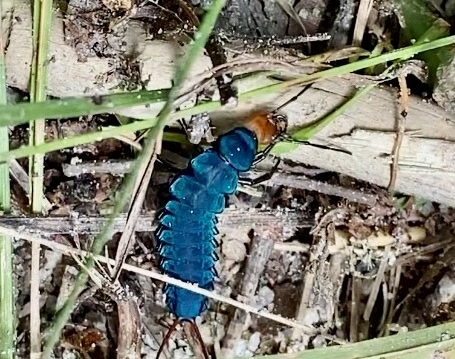
A while back I wrote something on whether a lion could kill a moose and I pointed out in that article that sometimes prey turn the tables on predators.  I just read something this morning that takes that one further.  This is not for the faint of heart — or for frog lovers — but there are beetles whose larvae lure frogs into trying to eat them.  The ferocious beetle larvae not only don’t get eaten, they kill and eat the frog!

I suppose we shouldn’t feel too badly for the frog since it was, of course, intent on eating the seemingly defenseless beetle larvae, but we tend to empathize with fellow vertebrates before other creatures, so watching the beetle larvae win the battle is unnerving.

Anyway, if you want to see something amazing and aren’t too partial to frogs, check this out:
blogs.discovermagazine.com/notrocketscience/2011/09/21/beetle-larva-lures-and-kills-frogs-while-the-adult-hunts-and-paralyses-them/

Share:
  • Digg
  • Facebook
  • Twitter
  • Google Bookmarks
  • RSS
  • del.icio.us
  • Reddit
Print Friendly Print Friendly

What’s with these crazy centipedes?

The Question: I recently moved to a small city, and I’m seeing centipedes regularly appear in my house at night. They’re light colored, many-legged, and usually whisking their way across the walls or ceiling. My question is, why? I was told that centipedes like to eat other bugs, and we don’t have a lot of other bugs. The only other insect we’ve seen is the occasional wandering ant. In the meantime, my insect-fearing spouse is taking a shoe into the bathroom with him every time nature calls.

Submitted by: Eleanor, West Virginia, USA

house centipededThe Short Answer: Wait! Before you get out the centipede-squashing shoe, you might want to consider the possible connection between these startling, but harmless, arthropods (insects, crustaceans, centipedes, spiders and the like) and your house’s relative lack of other crawling critters. In fact, you might want to thank your new friends.

Some experts believe the common house centipede (Scutigera coleoptrata) originated in the Mediterranean, but wherever it came from, it’s now found on every continent except Antarctica. You can find them under logs and leaves in temperate habitats, wherever it’s damp enough, but if you really want to find some Scutigera coleoptrata quickly, your best bet is people’s homes and basements.

There’s no doubt that these guys tend to trigger a startle reflex, in part because they are so fast. They are considered to be one of the speediest arthropod runners. They are also efficient and voracious hunters. They’ve been observed to hold one prey item in some of their many legs while catching another. And they hunt and eat all those other buggy-type critters that we don’t like in our houses: cockroaches, ants, silverfish, pillbugs, spiders … even other centipedes. And yes, you’ve heard that centipedes have a venomous bite, and that’s true. The toxins of many tropical centipedes can be quite painful. The house centipede’s toxin is relatively harmless, however, and it rarely bites, in part because it isn’t strong enough to break human skin easily. If you are one of the rare people to get bitten by one of these guys, it might register somewhere between a mosquito bite and a bee sting – nothing to have nightmares over.

So tell your husband that if he’s afraid of insects, he should welcome centipedes. They aren’t insects, for one thing, and in fact, they give insects nightmares. So tell him that when he sees them whisking their way across your walls or ceilings, he should just proudly say, “There go my little exterminators. Those Scutigera are the greatest, and they work for nothing!”

Other Interesting facts: Adult house centipedes have 15 pairs of legs (more on that later), but if you look closely, you’ll notice that the last pair is generally held up in the air. People who study these house centipedecentipedes believe those legs serve as rear antennae – sort of like back-up lights on a car.

Actually, there is one other pair of legs, but you wouldn’t be likely to count them. Turns out that the venomous pinchers at the head are actually the first set of legs, modified to grasp prey and inject a mix of toxins. So house spiders have 30 walking legs, plus two pincher-legs.

However, you might see a house centipede with fewer legs, in which case you are looking at a juvenile. House centipedes molt eight times. As with insects and other arthropods that metamorphose, the stages are called “instars.” The first two instars have no mouthparts and therefore don’t eat (or bite). They continue to develop using the food that was stored in the egg from which they hatched. The first instar has four pairs of legs, and subsequent instars have more pairs of legs until reaching the adult number of 15 pairs at instar six.

For more information on house centipedes, check out these sites:

http://www.uark.edu/ua/arthmuse/house_centipede.html

http://ento.psu.edu/extension/factsheets/house-centipedes

http://www.ipm.iastate.edu/ipm/iiin/housece.html

Oddly Enough, Centipedes Don’t Exist: We all know that centipedes are supposed to have 100 legs, right? Isn’t that what the “centi-” stands for? But as mentioned above, Scutigera coleoptrata has 15 pairs of legs, or 30 legs in total. Many of the roughly 3,300 centipede species have 15 pairs of legs, although some do have as many as 191 pairs. But you’ll never find a centipede with 100 legs, because that would imply that they have 50 pairs of legs, and the interesting fact is that all centipede species have an odd number of pairs of legs as adults (with only extremely rare exceptions, which appear to be malformed individuals).

Why would that be?

It might have to do with the way segments form in the developing centipede. It appears that segments are always formed in pairs. As the embryo grows from head to tail, each segment that is added divides into two segments, each with its own pair of legs. Since each segment divides in two, the end result is always an even number of segments. But wait, didn’t I say there’s always an odd
number of pairs of legs? Right. But don’t forget the pair of legs modified into pinchers. If you add in that pair of pincher-legs, you always have an even number of segments that have pairs of walking legs, just as you would expect if each segment forms and then divides.

Unfortunately, there are a couple of holes in this neat explanation. For one, we don’t yet know for sure that the pincher-legs are derived from a segment that divides.  It may follow a different developmental pathway from the other legs. If that’s true, then the simple explanation that dividing segments always leaves an odd number of leg segments seems to fall apart.

Also, as mentioned above, the first instar of Scutigera coleoptrata has four pairs of legs.  Add the pincher legs and you’ve got five leg segments.  How do you end up with five if segments are dividing?  It’s possible that in some instars, development stops before a segment divides, throwing out the general rule. But if that’s the case, you might expect that at least one of the thousands of species of centipedes might end up with an even number of leg segments. So far, none has been found.

We don’t yet know enough about how centipedes – and other arthropods – develop to answer these questions.

What we do know is that the odd-pairs-of-legs-only rule for adult centipedes holds very strongly. A hypothetical centipede species might have 49 walking leg segments, and therefore 98 legs, and another might have 51 segments, and therefore 102 legs. But given the constraints of the way centipedes develop, it appears that the name centipede is not only a misnomer, but an impossibility.

Thanks to Dr. Wallace Arthur, who heads up a team working in the relatively new field of evolution of development (“evo-devo”) in the Zoology Department of the Ryan Institute at the National University of Ireland in Galway.

Sources:

Arthur, W, & Chipman, AD. (2005). The centipede Strigamia maritima: What it can tell us about the development and evolution of segmentation. BioEssays, 27(6), 653-660.

Undheim, E A, & King, G F. (2011). On the venom system of centipedes (Chilopoda), a neglected group of venomous animals. Toxicon, 57(4), 512-524.

Minelli, A, Chagas Junior, A, & Edgecombe, G D. (2009). Saltational evolution of trunk segment number in centipedes. Evolution & development, 11(3), 318-322.

Edgecombe, G D, & Giribet, G. (2007). Evolutionary Biology of Centipedes (Myriapoda:  Chilopoda). Annual Review of Entomology. 52, 151-170.

Damen, W. (2004). Arthropod segmentation: Why centipedes are odd. Current biology, 14(14), R557-R559.

Acosta, C.A. (2003).  The House Centipede (Scutigera coleoptrata; Chilopoda):  Controversy and Contradiction.  Transactions of the Kentucky Academy of Science.  64(1), 1-5.


Share:
  • Digg
  • Facebook
  • Twitter
  • Google Bookmarks
  • RSS
  • del.icio.us
  • Reddit
Print Friendly Print Friendly

Jelly-like blob under the dock – part two

The Questions:
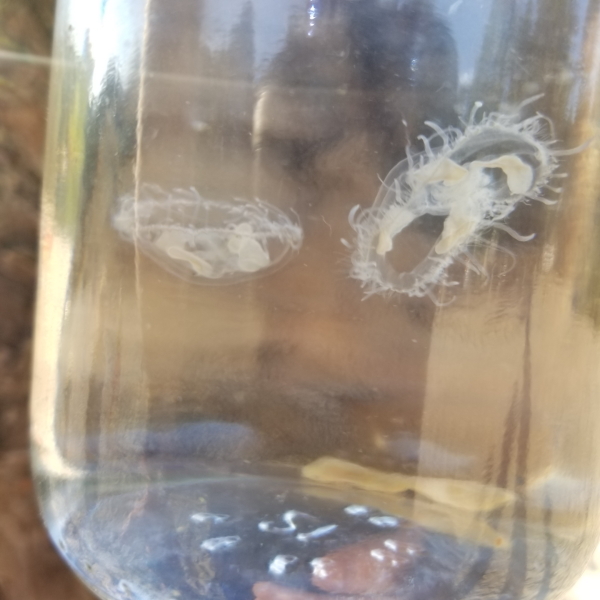
bryozoanRhonda, East Tennessee, USA – I found this in an East TN lake, between 1-3 feet down, attached to underwater pine branches, gelatinous and slimy to touch. Frog’s eggs or bryozoans? (see photo at left)

George, Ontario, Canada – I was cleaning the weeds from around our boat and saw two opaque jelly-like substances just below the surface of the water (looked like jelly fish) among the weeds. I caught one on the fork and removed it with the weeds, the other one quite large in size like a small football slipped of the fork and escaped. This was in the Trent canal system in the Bobcaygeon area. Has anyone else seen anything like this?

Marcus, USA – We recently found one of these blobs, too, around our beach as we were cleaning the weeds. I was interested in finding out what it is.

The Short Answer: I thought I’d respond to these all together since these have all come in the last few days. In all three cases, it’s almost certainly the bryozoan Pectinatella magnifica. I wrote an article on these a while back:

What is this jelly-like blob under my dock

The photograph Rhoda sent is definitely a bryozoan colony and I feel pretty confident in saying that the others are as well because the only other large blob-like things commonly found in fresh water in North America are amphibian egg masses. But as these three reports came in mid-late August, that’s very unlikely. Most amphibians lay eggs in the spring. And the descriptions are pretty classic bryozoan, with softball to football-sized jelly-like blobs found around docks and swimming areas.

Here’s another site with good info:

ALIEN LIFE FORMS? NO, JUST BRYOZOANS

More Information: I’m wondering why I received all three of these reports within a week of each other.  It could be simply chance, of course.  Or maybe it’s just that after a summer of growing, the bryozoan colonies are larger and more visible now.  Another possibility is that I have noticed in the lake I live on the water begins to clear at this time of year (mid-August).  I assume this happens because the algae, diatoms and other plankton populations start to die back as nights get colder and the day length is growing shorter.  It’s still hot, so we think of this as being still summer, but the longest day of the year was two months ago, so for the microscopic plants and animals at the bottom of the aquatic food chain, the peak growing season is past.  With less life going on in it, the water is less cloudy and people can see things underwater more clearly.

Maybe that’s the simple explanation.  As the water clears, people suddenly say, “What’s that jelly-like blob under my dock?”

Share:
  • Digg
  • Facebook
  • Twitter
  • Google Bookmarks
  • RSS
  • del.icio.us
  • Reddit
Print Friendly Print Friendly

What is that popping noise in the lily pads?

The Question: Sitting beside a small lake in Massachusetts with many lily pads, we kept hearing a popping noise, almost like bubblegum snapping. What makes that sound?

Submitted by: Greg, New York, USA

The Sort of Short Answer: Full disclosure: Greg was visiting me, and we were sitting beside the lake and he asked me, “What is that popping noise?” and I had to admit that although I have often wondered about it, I didn’t know the answer. So I decided it was time to find out.

First off, here’s a recording of the sound. You might have to turn your speakers way up to hear the pops.  There’s one at about two seconds, one at 11 and one at 16.

At this end of the lake, there is an area of maybe a little less than a hectare (about 2 acres) that is covered with several species of floating plants commonly called lily pads, extending out probably 50 meters (165 feet) from shore. If you listen on a good day, you’ll hear the pops every few seconds coming from the area of lily pads. My first thought was that something was falling into the water and plopping, but the pops come from the full extent of the lily pads, so too far away from the shore to be something falling from the trees that line the lake.

When I first tried to see what I could find on the web, I came up with fishing sites that say something similar to this:bluegill sunfish

“Besides looking for baitfish in the thicker weeds, Hannon tries to find signs of bluegill eating worms or grubs off the bottom of the dollar or lily pads. Holes appear in the pads when this action occurs, and one can actually hear the popping sound of the sunfish feeding.”

http://www.finefishing.com/1freshfish/aaspecies/basslargemouth/hannonguide.htm

pockmarked lily padsThat explanation made some sense to me. There are certainly many sunfish in this lake, including bluegill (Lepomis macrochirus), pumpkinseeds (Lepomis gibbosus) and green sunfish (Lepomis cyanellus). And from my snorkeling, I know they often hang out in the lily pads. And in fact, as this picture shows, many of our lily pads have sunfish-mouth-sized holes in them. But to confirm this theory, I asked Dr. Tim Copeland, a fisheries scientist with the Idaho Department of Fish and Game. He also thinks sunfish are a good possibility, but isn’t willing to rule out other fish. “I used to fly fish for bluegills in lily pads and caught fish when such popping noises were present. But I also caught fish when I didn’t hear any popping noises (and vice versa of course). So in my opinion it could be any species of fish that live in weedy pond habitats. For instance, small bass might pick dragonfly nymphs from the pads. But sunfish are probably the most common.”

I also asked, Dr. Eric Dibble, who teaches aquatic science and studies sunfish behavior at the College of Forest Resources at Mississippi State University. He is more willing to bet on sunfish:

“The small sunfishes (family: Centrarchidae) i.e., bluegill (there are many other different species) are mostly insectivores and typically feed on young and adult insects. These fish have adapted to gleaning small organisms out of the water column as well as off of plants, the surface, and bottom substrate. Their mouth parts are structured is such a way to extend slightly when feeding so to create a vacuum. When they feed on the water surface, whether under a lily pad or directly off the top, a sucking sound or ‘pop’ can frequently be heard.

“I have a pond full of bluegill sunfish, and I frequently sit outside listening to the feeding in the early evening when they do much of their feeding. I also have bluegill, redear and longear sunfishes in an aquarium inside the house; and many times in the evening their feeding ‘pops’ awaken me.

I asked Dr. Dibble about the fish popping at night. Though I hear the sound most often during the day, I sometimes hear pops late into the evening as well. He said, “Generally, the centrarchids (sunfishes) have pretty good vision at night and will feed 24 hours, however much of their intensive feeding takes place during twilight hours of the day (dawn and dusk).”

So, on the basis of all those reports, I feel pretty confident to say that it is fish making the popping noises with suction feeding on lily pads. Probably sunfish, but possibly including others.

What About the Holes: The other question then, is, “Are the fish poppers making the holes in the lily pads?” I was unable to verify this in the scientific literature, but I do have a couple of clues.

One piece of evidence is that there are lily pads in a shallow marsh connected to this lake by a culvert pipe.  I never see sunfish in that marsh, and the lily pads there are pristine, without the numerous holes that mark the lily pads in the open watlily pad with fish biteer part of the lake.

I got another tantalizing clue as I sat in a canoe, floating in the middle of lily pads, trying to record the pops, I heard one just to my right. When I looked in that direction, there was a lily pad jiggling wildly, as if something were in fact, pulling on it from underneath. When the movement stopped, I paddled over and discovered, as this photo shows, that the lily pad had what looked like a new hole. Notice that the edges of the center hole are freshly ragged and not browned, like the other holes.

This doesn’t qualify as proof, but I believe this hole was made in connection with the pop I heard.  I suspect it’s all connected. The popping noise comes from fish sucking tasty treats off the bottom of the lily pads, and the noise itself probably occurs when the leaf snaps, releasing the suction and creating a hole.  That’s why, after a long summer of feeding, the lily pads are pocked with holes.

And now, when guests ask me “What is that popping noise?” noise, I’ll have a better answer.

Share:
  • Digg
  • Facebook
  • Twitter
  • Google Bookmarks
  • RSS
  • del.icio.us
  • Reddit
Print Friendly Print Friendly

Amazing Video of Pollinators

I have fallen a little behind in responding to questions, but hopefully, I’ll start catching up in the next few days, but I wanted to share some amazing slow motion, time-lapse and close-up video of pollinators by filmmaker Louis Schwartzberg.

He talks for about three minutes about why he films flowers and their pollinators, but if you want to skip ahead to the actual video, go to 3:00. My favorite part is the incredible spiral aerial acrobatics of a hummingbird chasing an insect at about 3:50. Also, in connection with recent butterfly questions, just after 6:00 there is time-lapse video of a monarch butterfly coming out of its chrysalis and then video of two mating monarchs flying together.

Share:
  • Digg
  • Facebook
  • Twitter
  • Google Bookmarks
  • RSS
  • del.icio.us
  • Reddit
Print Friendly Print Friendly