Do Toads Eat Worms?

The Question: As I worked in the garden, an earthworm came wriggling toward me, followed by a toad. When the worm changed course, the toad followed, looking as if it wanted to bite the worm. Do toads eat worms?

Submitted by: Susan F., Connecticut, USA

The Short Answer: Yes!

More Information: Most toads will eat almost any animal small enough to fit in their mouths – and sometimes animals too big to fit in their mouths! So earthworms, insects, terrestrial crustaceans, and other invertebrates are all on the menu. One study in Canadian jack pine forests found that American toads were big eaters of ants. But nice juicy earthworms are probably a treat. So the toad you saw chasing an earthworm American Toadwas almost certainly after lunch. There is a Youtube video of a pet American Toad eating a large worm here: YouTube Clip.

Two toad species are common in Connecticut, the American Toad (Bufo Americanus), and Fowler’s Toad (Bufo fowleri). They can look very much alike. The American Toad gets considerably larger, so if you see a four inch (10 cm) toad (with legs tucked in) in Connecticut, that’s almost certainly an American Toad. But if you see one smaller than that, you’ll have to look more closely. The Peabody Museum at Yale University has a nice online guide to the amphibians and reptiles of Connecticut Fowler's Toad(Yale Peabody Museum). Here are that site’s descriptions of the two Bufo species:

American Toad – A brown or brownish gray toad of 3 to 4 inches (7.6 to 10 cm) in length. The brown spots on the back generally contain 1 or 2 wart-like protuberances. The belly is creamy white with a peppering of dark spots.

Fowler’s Toad – A medium-sized toad reaching 2 to 3 inches (5 to 7.6.cm) in length. Dorsal coloration is brown or brownish gray with brown or black markings surrounding the warty protuberances on the skin. Generally, three or more “warts” occur with each dark spot on the back. The belly is creamy white usually lacking dark speckles.

It sounds to me like the simplest way to tell an American Toad from a Fowler’s Toad would be to tip them over and look for dark spots on the belly. If it’s got spots, it’s probably an American Toad. If not, it’s a Fowler’s. That should work in Connecticut, where these are the only two species that are common. In other parts of the world, you’d have to know the local species. American Toads and Fowler’s Toads both like sandy soils. You’re more likely to find the American Toad in an upland area, and more likely to find a Fowler’s near a stream or other water, but both can be found in the other’s prime habitat, so that’s not a very good way to tell them apart. You can also listen for their songs in the spring to tell what kind predominates in your area. You can hear the songs at the Yale Peabody Museum site. The songs are roughly similar, but the American Toad’s song is prettier. The Fowler’s has a bit of a punk rock edge:

American Toad Song

Fowler’s Toad Song

There are about 150 species in the genus Bufo spread around the world, so it’s a pretty successful group. It even has an infamous member, Bufo marinus, the Cane Toad that has become a troublesome invasive species in many places. Bufo is the largest genus in the family Bufonidae, which has about 530 species, and is considered by herpetologists to be the “true toads.” However, in common name usage, there are many species of frogs that are also called “toads.” The name/description “toad” is generally given to any frog that lives in a dry habitat. Interestingly, convergent evolution has led to many of these frogs looking very much like bufonid toads, dry, warty skin and all.

Trivia: A group of toads is called a “knot.”

Sources: The diet of coexisting species of amphibians in Canadian jack pine forests.  Bellocq, M. I., K. Kloosterman, and S. M. Smith.  Herpetological Journal.  10:63–68.  2000.

Share:
  • Digg
  • Facebook
  • Twitter
  • Google Bookmarks
  • RSS
  • del.icio.us
  • Reddit
Print Friendly Print Friendly

Is Indian Pipe Rare?

The Question: I enjoyed your article on the Indian Pipe (at CuriousNature.net). I live in SE Wisconsin and I was thrilled to find some of these wonderful plants in my wooded yard. How rare is this plant? I have lived in this area all most all of my 50 years and have not seen one until last week.

Submitted by: Ava, WI

The Short Answer: There are many references on the web that call Indian Pipe (Monotropa uniflora) a “rare plant,” but I don’t believe that’s accurate. It has a very wide range, spanning most of the globe. In fact, one source claims it has a wider range of distribution on the globe than just about any other plant. The seeds are nearly microscopic and can be carried on the wind for long distances. However, Indian Pipe occurrence in any one location can be very spotty, because the plant needs just the right conditions and just the right hosts (fungi and trees). Obviously, in your area, it doesn’t occur very frequently.

More Information: Indian Pipe has a nearly worldwide distribution, but it may not all be one species. Botanists have long known that Indian Pipe varies in form from one place to another. Genetic analysis suggests that the Indian Pipe of North America and South America are genetically distinct from the Indian Pipe of Asia. Some scientists are “splitters” who want to describe any genetically distinct and reproductively isolated populations as separate species. Others are “lumpers” who would rather describe slightly different populations as subspecies or races rather than as separate species.

The Interesting Science: Indian Pipe is one of 400 or so species of “myco-heterotrophs.” Myco-heterotrophs are parasitic on fungi that are symbiotic with plants and trees. The fungi provide nutrients to the trees, the trees provide carbohydrates and other nutrients to the fungi … and myco-heterotrophs like Indian Pipe quietly live off the whole process. (See my article on Indian Pipe at CuriousNature.net for more explanation.) What’s interesting is that many of the myco-heterotrophs have evolved in a very similar way, despite the fact that they come from different families of plants. This is called “convergent evolution.” Because the plants are trying to survive in the same way, they may “find” the same solutions to the challenges of survival. For example, most plant seeds contain all the resources a seedling needs to get a good start and begin growing and photosynthesizing. But for a myco-heterotroph like Indian Pipe, that’s not necessary. They don’t need to photosynthesize because they parasitize the fungi and trees. So the seeds of a myco-heterotroph like Indian Pipe can be tiny. At the same time, the plant needs to distribute its seeds very far and wide, since only seeds that end up in just the right spot will find the fungi and conditions they need to survive in their rare lifestyle. So Indian Pipe produces tens of thousands of tiny seeds that can float on the wind and are distributed very far and wide.

The interesting thing is that so many of the other 400 myco-heterotrophs have found the same solution. Most of them produce large numbers of tiny wind-borne seeds. These illustrations of the seeds of three plants from different families are an example. These plants are from the lily family (j), the orchid family (k), and the heath and heather family (l – Indian Pipe). (Illustration adapted from Leake – see below for citation).

Sources: A Cladistic Analysis of Monotropa uniflora (Ericaceae) Inferred from Large Ribosomal Subunit (26S) rRNA Gene Sequences, Ray Neyland, Melissa K. Hennigan, Castanea 2004 69 (4), 265-271.

The Biology of Myco-Heterotrophic (‘Saprophytic’) Plants, Jonathan R. Leake, New Phytologist, Vol. 127, No. 2 (Jun., 1994), pp. 171-216.

Share:
  • Digg
  • Facebook
  • Twitter
  • Google Bookmarks
  • RSS
  • del.icio.us
  • Reddit
Print Friendly Print Friendly

What is this bird with a long white tail?


The Question: A seabird showed up every day to circle our sailboat 200-300 miles northeast of the Bahamas. One day there were 3 of them, but most days there was just one. It looked ‘gull-like’ and was very white with striking black trim around the trailing edge of his wing feathers. The tail is long and string-like in appearance (versus a fan of feathers). What bird is this?

Submitted by: Ed, NC


The Short Answer: Ed, your photos and description are perfect for a tropicbird. The long trailing tail is a giveaway. From your photo and the locality, I would guess that what you saw is a White-tailed Tropicbird (Phaethon lepturus), the smallest of the world’s three tropicbirds, with a wingspan of about three feet (94 cm). The other possibility would be the Red-billed Tropicbird (Phaethon aethereus), which is a bit larger, with a wingspan of 44 inches (112 cm). The Red-billed Tropicbird flies with shallow wingbeats and even at some height, the red bill is fairly visible. So unless you saw either of those clues, I feel pretty comfortable identifying your birds as White-tailed Tropicbirds.

More Info: The White-tailed Tropicbird spends most of its life flying over the ocean, eating fish and squid off the surface. Their best trick is catching flying fish on the wing … or on the fin, to be more accurate. The White-tailed Tropicbird is found throughout the tropical oceans of the world.

Share:
  • Digg
  • Facebook
  • Twitter
  • Google Bookmarks
  • RSS
  • del.icio.us
  • Reddit
Print Friendly Print Friendly

An encounter With Beavers

I spend most of the summer on a small lake in central Massachusetts. The lake empties through a culvert under a road and into a large marsh through which the water flows. The marsh goes under a footbridge, and around a couple of corners and eventually spills over a large beaver dam. That there are beavers active in the area is clear. Last fall, the trees right in front of my house were chewed, though not felled, by a beaver.

Last week, I bought a small, inflatable kayak, specifically so that I could paddle it across the lake to the road, carry it over the road and then continue on into the marsh. Two days after I bought the kayak, I was up early and decided to try it out. As I made my way through the marsh, I passed a beaver lodge. Just as I came up on it, I heard a slap on the water and saw a big splash. Slapping the water with the flat of their tail is a common beaver behavior. It makes a loud noise that is quite effective in its presumed intent to startle. While a potential predator recovers from the surprise, the beaver escapes in the water.

I never actually saw the beaver. I just heard the splash and saw the ripples left behind. As I moved a little further along in the marsh, I saw a beaver coming towards me. Whether the same or another beaver, I’m not sure. The beaver was swimming, as they do, with just its head exposed in the water, and it was carrying something. At first I thought it was carrying sticks, but I got out the binoculars to take a closer look and realized it was carrying a baby beaver, or kit, as they are called. When I first saw it, the beaver was maybe 50 or 60 feet away (15-18 meters), headed directly at me, and I sat still in the water in my bright yellow inflatable kayak. The beaver continued to get closer and closer with the limp baby in its mouth. As it grew really close, I began to get concerned as to what exactly the beaver’s intentions were as I sat there in a blow-up vinyl boat. Finally, when the beaver was about five or six feet away, mother beaver apparently noticed for the first time that there was a person in the yellow inflatable kayak in her way and, startled, she dove under the water … leaving her baby floating five feet from the kayak.

The kit at that point came out of its limp stupor and began swimming … right at my bright yellow kayak. So I paddled backwards a bit. The kit kept coming at me. I paddled back a bit more. The kit kept coming. Finally, I paddled back about thirty feet away, at which point the kit lost interest in me and began swimming in a big circle, making soft whimpering noises. I feared I had done something wrong and broken up a happy little beaver family. So I waited and hoped Mama beaver would come back to get her baby.

After watching and listening to the heartbreaking whimpers of the baby beaver for about five minutes, I began thinking, “Oh, great. I’m going to have rescue a baby beaver.” But just when I started thinking seriously about that, Mama beaver surfaced and began swimming with the baby. For a while they swam around each other, and the kit climbed on the mother’s back a couple of times. Finally, the mother took the baby in her mouth again and began to swim off. Relieved, I continued on my way through the marsh.

On the way back, however, when I came to the same part of the marsh, baby beaver was again swimming around whining. At this point, I was less worried about its safety than about my ability to paddle past it without it chasing me again. So I waited for it to move off to the side, and then quickly scooted past. A little further on, I saw another adult beaver, presumably Mama again, working in some reeds. It seems she was just giving baby beaver a little taste of independence.

A quick search on the internet didn’t turn up a lot of information, but I did find a couple of references to beavers moving kits when the mother beaver feels her kits might be in danger if left behind in the lodge. So maybe there was a fox or coyote in the area that made mama beaver nervous and that’s why she took her kit to work with her. I guess she didn’t count on meeting a bright yellow kayak. And then once she realized inflatable boats didn’t pose any particular threat, she just went back to being busy.

Anyway, it was ultimately an interesting encounter, and a nice christening for my new inflatable kayak.

Share:
  • Digg
  • Facebook
  • Twitter
  • Google Bookmarks
  • RSS
  • del.icio.us
  • Reddit
Print Friendly Print Friendly

What are these tiny oily beads in Lake Huron?

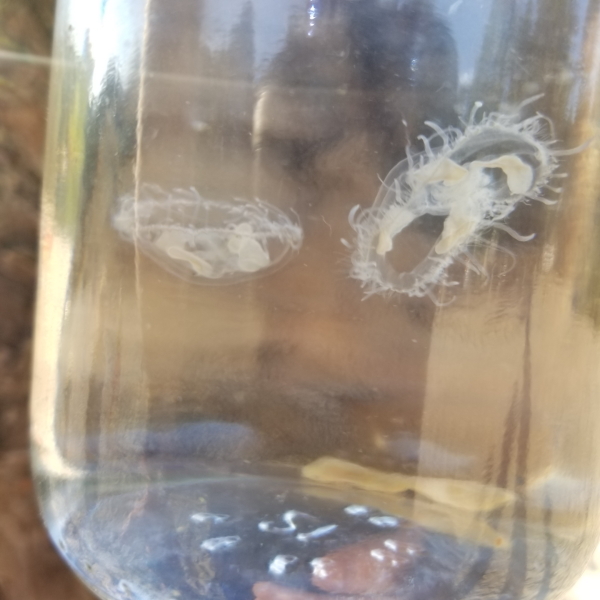
The Question: In Michigan in early July, thousands of tiny, clear, oily, bead-like things were scattered all over the beach along the water line. We were wondering if they were a natural occurrence or some kind of pollution.

Submitted by: Sara, MI

(The picture to the left was taken with a cell phone.)

The Short Answer: Both of the Lake Huron experts I contacted suggested that what you saw was Holopedium gibberum, a tiny cladoceran crustacean. Cladocerans, which include other small aquatic animals like daphnia, are part of the zooplankton of lakes and ponds. Like most cladocerans, Holopedium reproduces in two ways. Throughout the summer, females reproduce asexually through parthenogenesis, which means that females lay unfertilized eggs which hatch into more females – no males needed. In Holopedium, the developing eggs are carried in a brood pouch on the back of the female. This brood pouch can be twice as long as the female and looks like a gelatinous fish egg. When the density of Holopedium is high, they can wash up on beaches and look like what Sara saw on the shores of Lake Huron. Towards the end of the summer or early fall, some of the offspring will be male and sexual reproduction occurs. The result of this is fertilized “resting” eggs that survive the winter on the bottom of the lake. When these eggs hatch in the spring, they start the cycle over again.

The Environmental Issue:

While seeing Holopedium on the shore isn’t the result of pollution, as Sara feared, it’s probably not a good thing. Jim Johnson, Research Biologist/Manager at the Michigan Department of Natural Resources & Environment Alpena Fishery Research Station, explains:

“Holopedium has recently become more dominant in Lake Huron during late summer and their increase corresponds with changes wrought to the ecosystem by dreissenid mussels (zebra and quagga mussels) that invaded Lake Huron from the Caspian Sea region. The mussels got here via ballast water from ocean going ships. Evidently, the mussels have deprived Lake Huron of nutrients by filtering the lake of food and tying up nutrients in the mussel colonies on the lake bottom. Holopedium is a native zooplankton. It somehow manages to make a living in relatively sterile waters such as Lake Superior and, now, in Lake Huron. An abundance of holopedium is an indication that the water is exceptionally sterile (not very productive).”

Jim suggests that for more information, you can go to his office’s web page:

http://www.michigan.gov/dnr/0,1607,7-153-10364_52259_10951_11244—,00.html

At the following site, you can watch a trailer for a video about invasive species in Lake Huron:

http://www.lakeinvaders.com/Lake_Invaders.html

The Interesting Science: Animals like Holopedium that alternate between sexual reproduction and asexual reproduction are interesting test cases for hypotheses about the evolution of sex. An animal that reproduces asexually can essentially reproduce twice as fast as a sexually reproducing species. It seems that this would lead to a huge disadvantage for animals that reproduce sexually, and in the short term this seems to be true. However, scientists hypothesize that in the long term, animals that reproduce asexually can’t adapt as rapidly as sexually reproducing species because the offspring of an animal reproducing asexually are identical clones of the parent. The only variation would be a result of mutation. The offspring of animals reproducing sexually are a mixture of the genetic material of both parents, resulting in new combinations in every generation. Because there is so much more variety in the sexually reproducing species, some members will be more able to survive changes in the environment, new diseases, etc. Over time, it seems that the sexually reproducing lineage would be more likely to persist. This might explain why, although asexually reproducing species can multiply twice as fast as sexually reproducing species, the world is mostly filled with sexual reproducers. In fact, aside from some unusual rotifers, all the known parthenogenic species are relatively young in evolutionary terms. It seems that they just can’t last over the long run.

As for animals like Holpedium and other cladocerans, they seem to have figured out how to have the best of both worlds. In the spring and through the summer, their populations can grow rapidly through asexual, parthenogenic reproduction. But when fall comes, their thoughts turn to love, and they begin to reproduce sexually, mixing up their genes and creating new combinations ready to compete in the spring.

For more information on Holopedium, check out this site at Central Michigan University:

http://www.cst.cmich.edu/users/mcnau1as/zooplankton%20web/holopedium/holopedium.html

Share:
  • Digg
  • Facebook
  • Twitter
  • Google Bookmarks
  • RSS
  • del.icio.us
  • Reddit
Print Friendly Print Friendly